Most problems arrive already framed.
We need a new website. A better market. A measurement system. A heat pump. A strategy. A grant. A piece of software. The noun is usually clear enough that people can begin shopping for it.
The dangerous part is everything the noun has hidden.
A website problem may actually be a disagreement about who the organization serves. A carbon-market problem may be a question about who carries uncertainty and who gets paid first. A comfort problem may be an air-sealing, duct, electrical-service, financing, and trust problem wearing the shape of an equipment purchase.
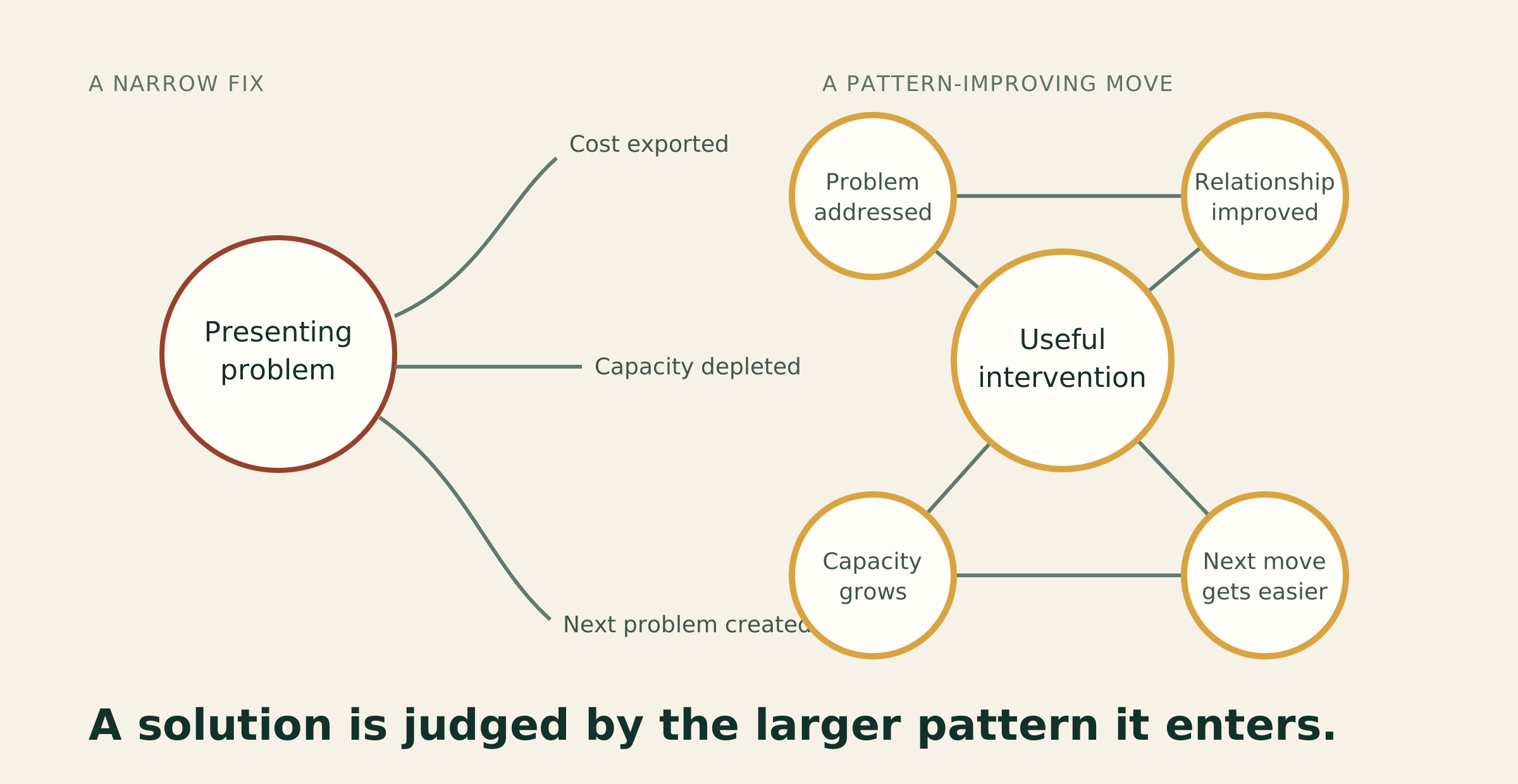
I named this practice after Wendell Berry's essay “Solving for Pattern” because he gives us a harder test than “Did the intervention work?” A narrow fix can succeed on its own terms while damaging the larger pattern that contains it. The new machine performs, but nobody can maintain it. The new metric is precise, but it rewards the wrong behavior. The new program wins funding, but it consumes the people required to run it.
The first discipline, then, is to resist solving too quickly.
Start by moving the boundary
Every problem statement draws a line around what counts.
Howard Silverman, whose long-running systems-design archive happens to share this practice's name, calls attention to boundary critique: deciding which facts, values, people, places, and time horizons are relevant is already a consequential act. The boundary is not neutral. It determines which benefits appear in the center of the picture and which costs disappear beyond the edge.
When I map a stuck pattern, I ask a few plain questions:
- Who is expected to change what they do?
- Who receives the value, and when?
- Who carries the risk or the extra work?
- What has to remain true for the solution to keep working?
- What happens one step upstream and one step downstream?
- What does the proposal make easier next?
Those questions do not produce a perfect map. Models are always partial. Their job is to make relationships discussable, not to impersonate the territory.
A good solution creates room
Berry's full list includes fourteen standards. I carry a shorter working synthesis into projects: start with limits and what is at hand; look beyond one discipline; solve more than one problem without creating the next one; use several measures of success; leave wide margins; ask how much is enough; notice who bears the cost; and prove the idea in work, in place, over time.
This changes what counts as leverage.
Leverage is often described as the smallest push that creates the largest effect. In living systems, that can sound more surgical than the work really is. I look instead for an intervention that creates room for several good things to happen together.
A customer-education tool can reduce anxiety, improve sales conversations, expose recurring operational problems, and help a contractor teach new staff. A soil-health program can improve measurement while reducing transaction burden and giving growers information useful beyond the market claim. A planning process can produce a decision and leave the team with a shared language for the next decision.
The artifact still has to be good. “Systemic” is not an excuse for vagueness. The page must load, the workflow must work, the numbers must be defensible, and the person at the other end must know what to do next.
Pattern is a verb
There is a temptation in systems work to admire the map.
The better map is not the goal. The point is to change what people can see and do together. That is why my method ends with teaching the work forward. If the useful pattern remains legible only while the consultant is in the room, it is not yet durable.
This also means the method is less linear than five numbered steps suggest. Listening changes the map. Building reveals a missing relationship. A pilot changes the question. Evidence sends us back to the people living with the result.
The pattern is not a hidden answer I arrive to discover. It is a set of relationships we learn to improve through attention, judgment, and work.
The practical test
Before calling something a solution, I try to ask:
- Did it address the presenting problem?
- Did it improve at least one important relationship around that problem?
- Did it push a cost, risk, or burden somewhere we chose not to look?
- Did the people who must carry it gain capacity and agency?
- What good next move is now easier?
That last question is the one I return to most.
A good solution does not close the system around itself. It creates more possibility: more understanding, more capability, more resilience, more honest choices. It creates more solutions.
That is what I mean by solving for pattern.
Sources and lineage
- You can read Wendell's seminal 1980 essay in full here, which is reprinted in The Gift of Good Land: Further Essays Cultural & Agricultural by Counterpoint Press.
- Howard Silverman, Boundary Critique and Systems Literacy.